
KPV: the alpha-MSH-derived tripeptide studied for gut inflammation
KPV is a three-amino-acid fragment of alpha-MSH (Lys-Pro-Val) with the unusual property of being one of very few peptides studied for oral delivery to inflamed gut tissue. This page covers what it is, how it works, what the preclinical evidence supports, why it is not yet a validated clinical therapy, and where it sits relative to alpha-MSH. Educational only, no doses.
For educational purposes only, not medical advice. This page is written for patients and the general public learning the science. It is not clinical guidance and does not recommend any peptide, dose, or treatment plan. Consult a licensed healthcare provider before using any peptide product.
KPV is a tripeptide of lysine, proline, and valine corresponding to the C-terminal fragment of alpha-MSH, the 13-amino-acid melanocortin hormone derived from POMC. It concentrates the anti-inflammatory motif of alpha-MSH while minimizing the pigment-related signaling. Its small size and PepT1-mediated transport into intestinal epithelial and immune cells are the mechanistic basis for an unusually coherent oral gut-targeting story, but the evidence base for human disease remains preclinical.
What is KPV?
KPV is the alpha-MSH C-terminal tripeptide Lys-Pro-Val, also written as alpha-MSH(11-13). It was developed as a minimal-sequence strategy to keep alpha-MSH's anti-inflammatory effects while shedding the pigment and melanotropic signaling associated with the full-length hormone.
alpha-MSH is one of the peptide products of proopiomelanocortin (POMC) processing, and it has broad anti-inflammatory effects across skin, gut, central nervous system, airway, and arthritis-related models [1]. The practical problem is that melanocortin receptor agonism, especially at MC1R, also drives pigmentation, which is a real clinical liability in many target indications. Researchers therefore mapped where the anti-inflammatory motif sat within alpha-MSH and converged on the C-terminal three residues, KPV, as the smallest fragment that retained the anti-inflammatory phenotype in multiple models.
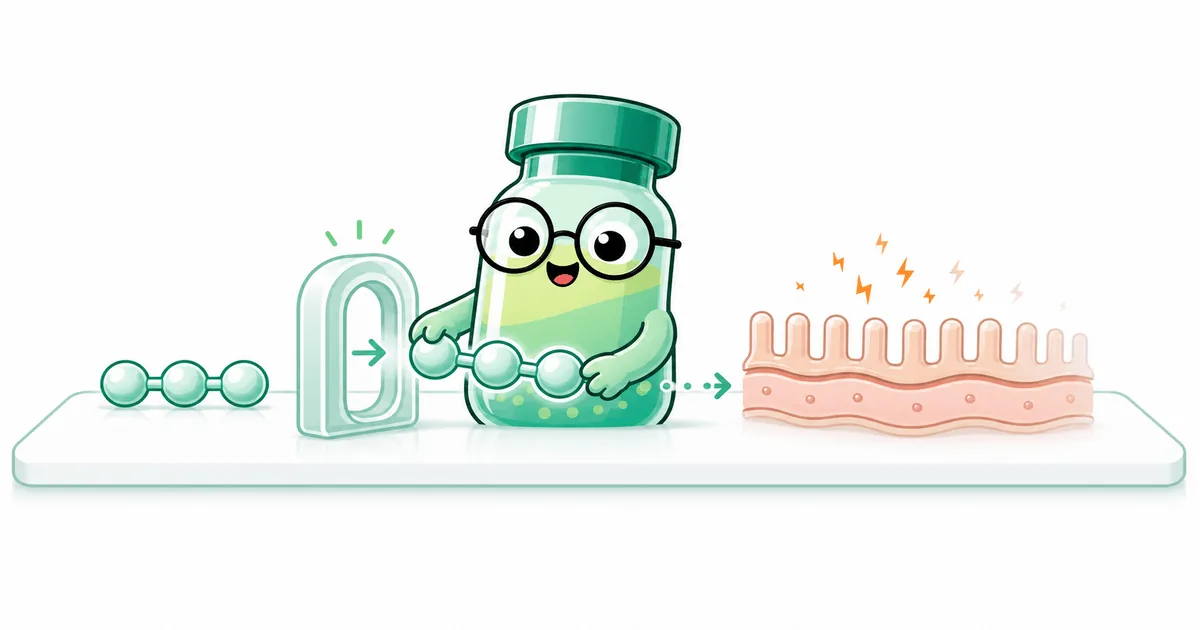
The small size has two pharmacology consequences worth knowing. On the negative side, tripeptides are short, generally lack stable tertiary structure, and are vulnerable to enzymatic degradation; KPV-specific stability-indicating HPLC work confirms degradation under acid, alkali, and oxidative stress. On the positive side, tripeptides like KPV are substrates of PepT1, a di- and tripeptide transporter expressed on intestinal epithelial and immune cells, which gives KPV an active transport route into inflamed gut tissue that most larger peptides do not have [2].
How does it work?
In inflammation models KPV reduces NF-kB pathway activation, lowers pro-inflammatory cytokines like TNF-alpha, IL-1beta, and IL-6, and reduces inflammatory cell infiltration. It also engages PepT1 transport in the gut, which delivers it intracellularly in epithelial and immune cells. It can act independently of canonical melanocortin receptor signaling in several models.
The core anti-inflammatory signaling story is consistent across systems. KPV reduces NF-kB activity and nuclear signaling in inflammatory models [2], and that reduction is reflected downstream as lower TNF-alpha, IL-1beta, and IL-6 output and as lower myeloperoxidase and inflammatory-cell infiltration in colitis and peritonitis-like settings [3]. The NF-kB connection is the cleanest molecular handle the literature offers for why KPV behaves the way it does in disease models.
The receptor-biology story is more complicated and is one of the most interesting teaching points on this page. KPV often retains anti-inflammatory activity in settings where canonical MC1R signaling is non-functional, and some cell models show weak or absent cAMP responses, suggesting that at least part of the effect is melanocortin-receptor-independent [1]. Other cell models show calcium-linked signaling and context-dependent receptor interactions, so the mechanism is likely mixed and tissue-specific rather than a single clean pathway.
The PepT1 story is what makes KPV unusual among anti-inflammatory peptides. Dalmasso and colleagues showed in 2008 that KPV is taken up via PepT1 on intestinal epithelial and immune cells, and that this uptake is linked to its anti-inflammatory effects [2]. PepT1 is upregulated in inflamed intestinal tissue, which turns an inflammation context into a selective delivery opportunity, the opposite of how most systemic drugs behave.
What does the evidence show?
KPV's strongest evidence base is in preclinical models of inflammatory bowel disease, including DSS colitis, TNBS colitis, and T-cell transfer colitis. Nanoparticle and hydrogel oral delivery systems have extended those results with colon-selective release. Human efficacy trials in IBD have not been established and the substance is not approved for any indication.
The IBD preclinical program is the strongest single body of work on KPV. Dalmasso and colleagues reported that oral KPV improved DSS and TNBS colitis outcomes in mice with reduced inflammatory signaling and improved histology [2]. Kannengiesser and colleagues independently showed that KPV improved DSS and T-cell transfer colitis with reduced myeloperoxidase, fewer infiltrates, and better recovery [3]. Laroui and colleagues then showed that KPV-loaded nanoparticles in an alginate-chitosan hydrogel improved DSS colitis with colon-selective release behavior [4], and Xiao and colleagues showed that hyaluronic-acid-functionalized KPV nanoparticles achieved better epithelial and macrophage targeting with improved mucosal healing and TNF-alpha reduction [5].
The colitis-associated cancer extension is also worth knowing. Wang and colleagues reported that KPV reduced tumor multiplicity and inflammatory signaling in mouse colitis-associated cancer paradigms, with PepT1-linked mechanism [6]. That is mechanistically interesting because it tracks the same transporter-driven story into a tumor-promotion endpoint rather than only an inflammation endpoint.
Outside the gut, the evidence is thinner. Historical alpha-MSH(11-13) work shows suppression of acute inflammation and contact-sensitivity responses in skin models, and KPV has demonstrated transdermal feasibility in human skin only with delivery enhancement (microneedles or iontophoresis), so topical use is technically possible but pharmacologically demanding. For arthritis and neuroinflammation, most of the supportive data are at the alpha-MSH(11-13) level rather than at the direct KPV-disease-trial level, and that distinction should be respected when reading marketing copy that conflates them.
Regulatory status
KPV is not FDA approved as a drug for any indication. It was listed under section 503A as a bulk substance that may present significant safety risks (Category 2) until April 15, 2026, when the FDA removed it along with eleven other peptides, effective April 22. On July 23-24, 2026 the Pharmacy Compounding Advisory Committee voted, non-bindingly, to recommend KPV for the 503A bulks list, over FDA reviewers who opposed all seven peptides on the agenda. The FDA has not adopted that recommendation, so KPV is still not approved and still not legal to compound. A public clinical-trials registry search did not identify established interventional efficacy trials specifically for KPV.
The FDA position is the most important regulatory fact on this page. KPV sat for years in the agency's Category 2 bulk-substances safety-risk context, alongside other unapproved peptides like AOD-9604 and MOTS-c, because the human exposure data and safety information were judged inadequate to determine the risk-benefit profile [7]. The April 2026 removal from Category 2 lifted that objection and made a formal review possible; it was not an approval and did not authorize compounding. The July 2026 committee vote is likewise advisory: the FDA weighs it, decides separately, and any addition to the 503A bulks list then runs through formal rulemaking that takes months. Until that finishes, none of this is an approval pathway that has been completed, and KPV cannot legally be compounded.
The market activity for KPV is therefore largely research-use and compounding-policy dependent rather than approved-therapy status. Peptide-vendor protocols and community dose ranges that circulate online do not derive from FDA-cleared dose-finding work and do not have the quality-control framework that approved drugs operate under. Product purity, identity, and endotoxin testing vary substantially across grey-market vendors.
Safety and what is unknown
Preclinical and cell-line work has generally reported anti-inflammatory effects without major overt toxicity in study windows, but this does not establish human safety. The FDA's Category 2 listing specifically noted the absence of an identified human exposure dataset sufficient to characterize harm, and the 2026 removal of that listing did not supply the missing data. Long-term, multi-year human safety data for KPV do not exist.
The published preclinical and cell-biology safety signal across animal studies is broadly favorable in short windows. Intestinal-cell biocompatibility has been reported in hyaluronic-acid-functionalized KPV nanoparticle work, and disease models have not raised obvious toxicity flags [5]. The practical caveat is that "few reported severe effects in preclinical literature" is not the same as established human safety, and the FDA listing makes that distinction explicit.
Non-clinical risk domains that any beginner should be aware of include product-quality variability in grey-market sources, the absence of standardized handling and shelf-life data outside specialized labs, and the absence of validated human dose-finding work. These are not unique to KPV but they are particularly relevant because KPV is often discussed as orally usable in community settings, and oral use does not bypass the underlying quality and exposure-data gaps.
Where it fits in peptide therapy
KPV sits inside the alpha-MSH and melanocortin family and is the canonical minimal anti-inflammatory tripeptide. Its most distinctive feature is the PepT1-mediated oral gut-targeting platform, which is uncommon in peptide pharmacology. It is closely related to KdPT and to the (CKPV)2 dimer, both of which appear in the same anti-inflammatory tripeptide conversation.
Relative to full-length alpha-MSH (1-13), KPV shares the anti-inflammatory phenotype while shedding much of the melanocortin-receptor agonism and pigment-related signaling that complicate full-length alpha-MSH for many indications. The tradeoff is that KPV has less mature clinical evidence than any approved IBD therapy, and "less pigment baggage" does not by itself substitute for a controlled efficacy trial.
Relative to related tripeptide derivatives, KdPT has strong anti-inflammatory and non-pigment findings in intestinal and psoriasis-like models and is often used as a comparator platform, and (CKPV)2, a dimeric analog, has shown comparable or better potency than KPV in some endotoxin and inflammation studies. For adjacent anti-inflammatory and tissue-repair peptide biology, the GI repair angle continues in BPC-157; for melanocortin-receptor biology in a pigment and appetite context the canonical comparator is melanotan 2; and the foundational anti-inflammatory pathway story is covered in our free how peptides work module.
Frequently asked questions
KPV is a tripeptide composed of lysine, proline, and valine (Lys-Pro-Val). It corresponds to the C-terminal fragment of alpha-MSH (alpha-MSH(11-13)) and concentrates the anti-inflammatory motif of the larger hormone while minimizing the pigment-related signaling associated with full-length alpha-MSH.
No. KPV is not FDA approved as a drug for any indication. The FDA removed it from the Category 2 bulk-substances safety-risk list in April 2026, and on July 23-24, 2026 the Pharmacy Compounding Advisory Committee voted, non-bindingly, to recommend it for the 503A bulks list, against the FDA's own reviewers. A committee recommendation is not an FDA decision, so KPV is still not approved and still not legal to compound.
In inflammation models KPV suppresses NF-kB activity, reduces pro-inflammatory cytokines like TNF-alpha and IL-6, and lowers inflammatory-cell infiltration. In the gut, KPV is taken up via the PepT1 di- and tripeptide transporter on intestinal epithelial and immune cells, which is the mechanistic basis for its oral delivery story.
No. KPV has a strong preclinical evidence base in mouse colitis models (DSS, TNBS, T-cell transfer) and a coherent oral gut-targeting platform, but human interventional efficacy trials in IBD have not established it as a clinical therapy. It is currently best framed as a promising preclinical platform, not validated treatment.
alpha-MSH is the full 13-amino-acid hormone and activates multiple melanocortin receptors, including pigment-relevant MC1R. KPV is the C-terminal three residues and can act independently of canonical melanocortin receptor signaling in several models, retaining anti-inflammatory effects with less melanotropic baggage. Its small size also enables PepT1 transport, which alpha-MSH cannot use.
This page is the free overview. For a structured deep dive covering the alpha-MSH and melanocortin background, the NF-kB and PepT1 mechanisms, the preclinical IBD platform, and the regulatory state, see the KPV mastery course.
References (7)
- Getting SJ, Schioth HB, Perretti M. Dissection of the anti-inflammatory effect of the core and C-terminal (KPV) alpha-melanocyte-stimulating hormone peptides. J Pharmacol Exp Ther. 2003;306(2):631-637. PMID 12750433.
- Dalmasso G, Charrier-Hisamuddin L, Nguyen HT, et al. PepT1-mediated tripeptide KPV uptake reduces intestinal inflammation. Gastroenterology. 2008;134(1):166-178. PMID 18061177.
- Kannengiesser K, Maaser C, Heidemann J, et al. Melanocortin-derived tripeptide KPV has anti-inflammatory potential in murine models of inflammatory bowel disease. Inflamm Bowel Dis. 2008;14(3):324-331. PMID 18092346.
- Laroui H, Dalmasso G, Nguyen HT, et al. Drug-loaded nanoparticles targeted to the colon with polysaccharide hydrogel reduce colitis in a mouse model. Gastroenterology. 2010;138(3):843-853. PMID 19909746.
- Xiao B, Xu Z, Viennois E, et al. Orally targeted delivery of tripeptide KPV via hyaluronic acid-functionalized nanoparticles efficiently alleviates ulcerative colitis. Mol Ther. 2017;25(7):1628-1640. PMID 28143741.
- Wang H, Chen J, Hollister K, et al. Anti-inflammatory and anti-colitis effects of the tripeptide KPV in experimental colitis-associated cancer. Int J Cancer. 2016. PMID 27458604.
- U.S. Food and Drug Administration. Certain Bulk Drug Substances for Use in Compounding that May Present Significant Safety Risks (KPV was listed in 503A Category 2 until the April 2026 removal).
Ready to go deeper?
Our KPV mastery course covers the alpha-MSH and melanocortin background, the NF-kB and PepT1 mechanisms, the preclinical IBD platform, and the regulatory state with interactive tools. Preview unit 1 free.
See the course ›