GHRP-2: the diagnostic-grade growth hormone releasing peptide-2
GHRP-2 (also known as pralmorelin or KP-102) is a second-generation ghrelin-receptor agonist that produces a stronger and more selective GH pulse than its predecessor GHRP-6. This page covers what it is, how it works, the published clinical and research evidence, and where it sits in the wider family of GH secretagogues. Research peptide, not FDA-approved in the US for human use. For educational purposes only.
Research peptide, not FDA-approved for human use in the US. For educational purposes only, not medical advice. This page describes investigational science for patients and the general public. It is not clinical guidance and does not recommend any peptide, dose, or treatment plan. Consult a licensed healthcare provider before considering any peptide product.
GHRP-2 is a synthetic hexapeptide ghrelin-receptor agonist that drives a brisk pulse of growth hormone from the pituitary. Originally developed under the codename KP-102 and known generically as pralmorelin, it is the second-generation cousin of GHRP-6 with a stronger and more selective GH-releasing effect. It has dedicated regional approval as a diagnostic agent in Japan but no FDA approval in the US.
What is GHRP-2?
GHRP-2 is a six-amino-acid synthetic peptide that engages the ghrelin receptor and triggers GH release. Its generic name is pralmorelin and its development codename was KP-102. Compared with the first-generation GHRP-6, GHRP-2 has higher potency at GHSR-1a and a slightly cleaner downstream profile, although it still drives modest increases in cortisol and prolactin alongside the GH pulse.
Ghigo and colleagues in European Journal of Endocrinology in 1997 reviewed the GHRP family at the moment when GHRP-2 was emerging as the most clinically useful member [1]. The review explicitly notes the synergy between GHRPs and GHRH, which is the property that turned GHRP-2 into a diagnostic combination test for assessing pituitary GH reserve.
The diagnostic use is where GHRP-2 has its single solid regulatory footprint. In Japan, GHRP-2 was approved in 2006 under the pralmorelin name as a single-injection stimulation test for adult growth hormone deficiency. That approval has not been pursued in the US or EU, so GHRP-2 in those markets is sold and discussed as a research compound rather than as a drug.
How does it work?
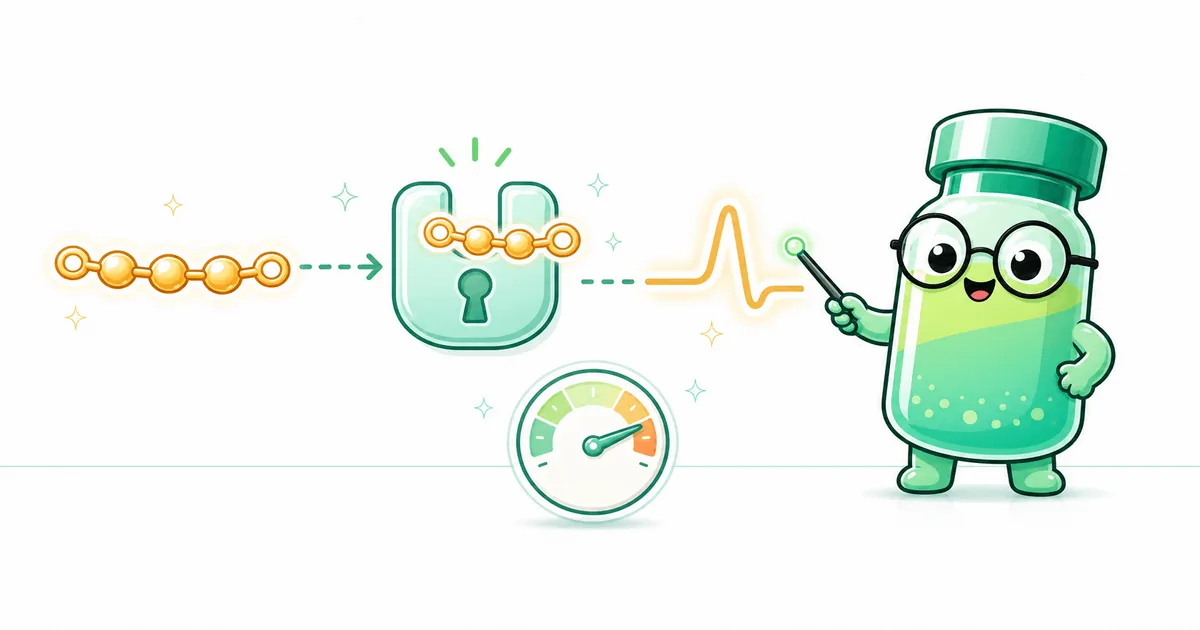
GHRP-2 binds the growth hormone secretagogue receptor GHSR-1a on pituitary somatotropes and on hypothalamic neurons. Pituitary activation drives a pulse of GH; hypothalamic activation stimulates appetite through arcuate-nucleus circuits. The GH pulse from GHRP-2 is markedly amplified when combined with GHRH, which is the basis for the combined-stimulus diagnostic test.
Hudson and colleagues in The Journal of Clinical Endocrinology & Metabolism in 2010 used submaximal GHRP-2 (and GHRH) drives in healthy women under an estrogen clamp to map how menopausal age and estradiol modulate the resulting GH pulses [2]. The study confirmed that secretagogue type interacts with sex-steroid context: the GHRP-2 stimulus produced a different pulse profile in pre- versus postmenopausal women even when estradiol was matched.
The appetite effect is well documented in humans. Laferrère and colleagues in The Journal of Clinical Endocrinology & Metabolism in 2005 reported that GHRP-2 infusion in healthy men increased food intake by approximately 36 percent versus placebo, with subjects eating roughly 9409 versus 7118 kJ over a fixed observation window [3]. That finding established GHRP-2 as a working pharmacological probe for the ghrelin-appetite axis in humans, not just in mice.
What does the evidence show?
GHRP-2's strongest evidence base is in its diagnostic role for adult GH deficiency in Japan and in proof-of-concept studies of appetite and GH-pulse physiology. The long-term body-composition or athletic-performance literature in healthy adults is thin and uncontrolled, similar to other GH secretagogues.
Perboni and colleagues in World Journal of Gastroenterology in 2008 reported that GHRP-2 reversed the anorexia associated with 5-fluorouracil chemotherapy in colon-cancer-bearing mice [4]. That work captures the through-line of how ghrelin-receptor agonists like GHRP-2 keep being explored as supportive-care tools for cachexia and chemotherapy-induced anorexia.
On the formulation side, Hu and colleagues in AAPS PharmSciTech in 2015 synthesized a mono-PEGylated GHRP-2 conjugate and showed it retained biological activity with a longer effective half-life [5]. That kind of half-life engineering is the practical limit on GHRP-2's clinical utility: the native peptide has a short half-life and requires injection, which is awkward for any chronic indication.
Sigalos and Pastuszak's 2018 review in Sexual Medicine Reviews consolidates the safety and efficacy data for the GH secretagogue class, including GHRP-2 alongside GHRP-6, hexarelin, and ipamorelin [6]. The review concludes that GH secretagogues reliably raise GH and IGF-1 in the short term but that controlled human evidence for the body-composition or anti-aging endpoints they are most often marketed for is weak.
Regulatory and research status
GHRP-2 (pralmorelin) is approved as a diagnostic agent for adult GH deficiency in Japan and has no FDA approval in the US. In the US it is sold as a research-use-only peptide. The Japanese approval is for a single-injection stimulation test in suspected pituitary disease, not for chronic therapeutic use.
GHRP-2 is on the World Anti-Doping Agency prohibited list under category S2 (peptide hormones, growth factors, related substances and mimetics) at all times. Any competitive athlete in a WADA-tested sport should be aware that use is banned in and out of competition, and that ghrelin-receptor agonists are specifically flagged on the prohibited list.
Safety considerations
In the published short-term human work, GHRP-2 has been generally well tolerated. It produces small increases in cortisol and prolactin alongside the GH pulse, increases appetite, and can cause transient facial flushing. Long-term safety in healthy adults using compounded research-peptide formulations has not been characterized.
The cortisol and prolactin elevations are smaller than those seen with GHRP-6 but larger than those with ipamorelin. That places GHRP-2 in a middle position on selectivity within the GH-secretagogue family.
The appetite stimulation is biologically expected from a ghrelin-receptor agonist and is the basis for several cachexia and chemotherapy-anorexia research programs. In the body-composition context that same property is a tradeoff, not a benefit.
Where it fits in peptide research
GHRP-2 sits between GHRP-6 and ipamorelin in the ghrelin-receptor-agonist family, with stronger potency than GHRP-6 and less selectivity than ipamorelin. All three are mechanistically distinct from GHRH-axis tools like tesamorelin, which engage a different pituitary receptor.
The most useful comparison among GHRPs is on the cortisol-prolactin axis. GHRP-6 raises both alongside the GH pulse and causes the strongest hunger. GHRP-2 raises both less than GHRP-6 but more than ipamorelin, and produces a stronger GH pulse than either. Hexarelin raises a similar GH pulse to GHRP-2 but adds CD36 binding and cardiovascular effects that the others do not share.
For a broader map of the GH axis and where the GHRP family sits within it, the underlying biology is covered in our free peptides and your body module. For how to evaluate any compound sold under a research-use-only label, our vetting research peptides guide covers the practical checks.
Frequently asked questions
GHRP-2 (pralmorelin, KP-102) is a synthetic hexapeptide ghrelin-receptor agonist that produces a brisk pulse of growth hormone from the pituitary. It is the second-generation cousin of GHRP-6 with a stronger and more selective GH-releasing effect.
No, GHRP-2 is not FDA-approved in the US. It was approved in Japan in 2006 under the name pralmorelin as a diagnostic agent for adult growth hormone deficiency. That approval is regional and does not extend to the US, where GHRP-2 is sold as a research-use-only peptide.
GHRP-2 binds the growth hormone secretagogue receptor GHSR-1a, the same receptor used by ghrelin. Activation triggers a pulse of GH from the anterior pituitary and stimulates appetite through hypothalamic ghrelin pathways. The GH pulse is stronger than that produced by GHRP-6 but smaller than the combined GHRP-2 plus GHRH stimulus.
Yes. Laferrère and colleagues in 2005 showed that GHRP-2 infusion in healthy men increased food intake by roughly a third compared with placebo, with subjects eating about 9409 versus 7118 kJ in the treatment versus control conditions. That appetite-stimulating property is a feature in cancer-anorexia research and a tradeoff in body-composition use.
GHRP-2 produces small increases in cortisol and prolactin alongside the GH pulse, similar to other ghrelin-receptor agonists. The short-term diagnostic-use safety profile is well characterized in Japan, but long-term safety in healthy adults using compounded research-peptide formulations is not. GHRP-2 is on the WADA prohibited list.
All three are ghrelin-receptor agonists. GHRP-2 produces a stronger GH pulse than GHRP-6 and has dedicated regional approval as a diagnostic agent. Ipamorelin engages the same receptor but is more selective, with minimal cortisol or prolactin elevation. GHRP-2 sits between GHRP-6 and ipamorelin in both potency and side-effect profile.
References (6)
- Ghigo E, Arvat E, Muccioli G, Camanni F. Growth hormone-releasing peptides. Eur J Endocrinol. 1997;136(5):445-460. PMID 9186261.
- Hudson SB, Schroeder DR, Bailey JN, et al. Pre- versus postmenopausal age, estradiol, and peptide-secretagogue type determine pulsatile growth hormone secretion in healthy women: studies using submaximal agonist drive and an estrogen clamp. J Clin Endocrinol Metab. 2010;95(1):353-360. PMID 19858315.
- Laferrère B, Abraham C, Russell CD, Bowers CY. Growth hormone releasing peptide-2 (GHRP-2), like ghrelin, increases food intake in healthy men. J Clin Endocrinol Metab. 2005;90(2):611-614. PMID 15699539.
- Perboni S, Bowers C, Kojima S, Asakawa A, Inui A. Growth hormone releasing peptide 2 reverses anorexia associated with chemotherapy with 5-fluorouracil in colon cancer cell-bearing mice. World J Gastroenterol. 2008;14(41):6303-6305. PMID 19009643.
- Hu X, Xu B, Zhou Z. Synthesis of mono-PEGylated growth hormone releasing peptide-2 and investigation of its biological activity. AAPS PharmSciTech. 2015;16(5):1213-1219. PMID 25761386.
- Sigalos JT, Pastuszak AW. The safety and efficacy of growth hormone secretagogues. Sex Med Rev. 2018;6(1):45-53. PMID 28400207.
Want the full peptide library?
The Academy subscription unlocks our full library of mastery courses, interactive tools, and reference content covering the peptide landscape from GH-axis tools to GLP-1 analogs. No GHRP-2 course yet; this overview is the current free reference.
See Academy pricing ›