
Epitalon analogs: epithalamin and the pineal tetrapeptide family explained
Epitalon (AEDG) is the synthetic tetrapeptide that grew out of an older Soviet-era pineal extract called epithalamin. This page is the family overview: what epithalamin was, how epitalon came out of it, the related short pineal peptides, and where the evidence base actually stands. For the main single-peptide page, see /peptides/epitalon. Educational only, no doses.
For educational purposes only, not medical advice. This page is written for patients and the general public learning the science. It is not clinical guidance and does not recommend any peptide, dose, or treatment plan. Consult a licensed healthcare provider before using any peptide product.
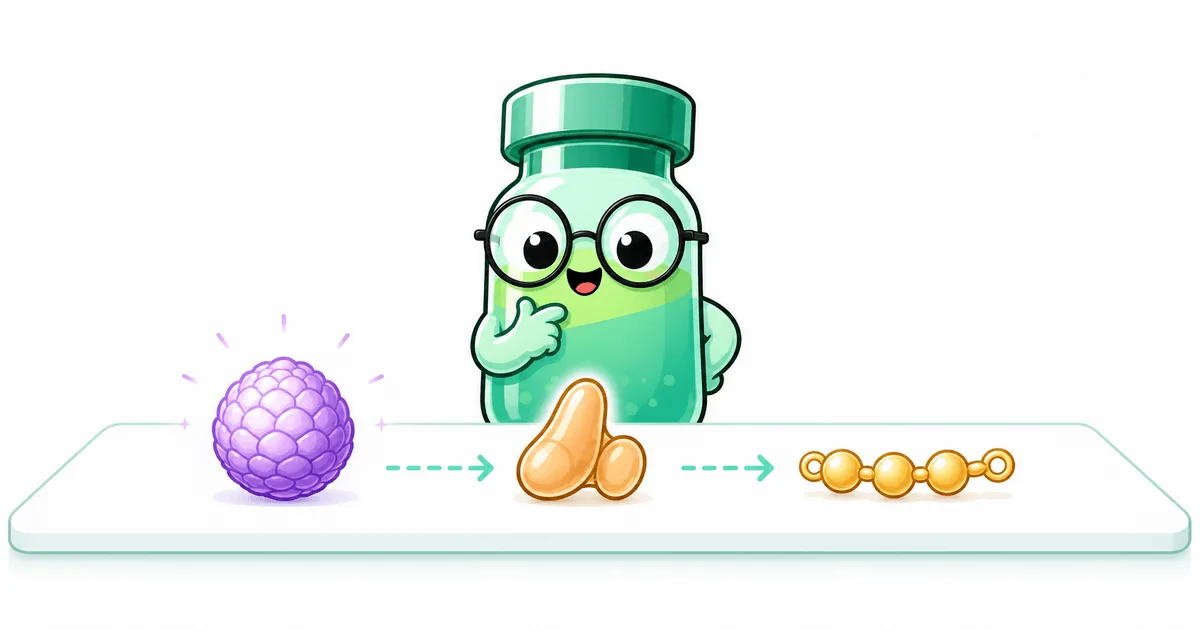
The epitalon family starts with epithalamin, a crude bovine pineal extract developed in 1970s Leningrad by Vladimir Khavinson, and ends with epitalon (AEDG), a synthetic tetrapeptide intended as a chemically defined version of the pineal activity. A small number of related short pineal peptides (pinealon and others) sit alongside it. The family is internally consistent but rests heavily on one research lineage and is not approved anywhere as a medicine.
Where the family came from
The family begins with Soviet-era organ-extract research. In the 1970s Vladimir Khavinson's group at the Military Medical Academy in Leningrad developed a series of partially purified peptide preparations from animal organs, including epithalamin from bovine pineal gland. Epithalamin was the parent product; epitalon is the chemically defined modern descendant.
The original program was based on a particular hypothesis: that each tissue produces short peptide signals that regulate cell turnover in that tissue, and that aged or dysfunctional tissue can be "renormalized" by administering the corresponding peptide preparation. The early work used crude or partially purified extracts, including epithalamin (pineal), thymalin (thymus), and prostatilen (prostate), each of which became a registered preparation in the Soviet and later Russian system [1]. None of these reached FDA review or EMA approval.
The move from extracts to defined sequences came in the 1990s. Khavinson's group sequenced and synthesized short peptides intended to represent the active fraction of the older extracts, and named them with the suffix "-on": epitalon (epithalamin), thymogen and thymalin's defined version, cortagen (cortex), pinealon (pineal-related), and several others. Epitalon, the synthetic tetrapeptide Ala-Glu-Asp-Gly (AEDG), is the prototype of the defined-sequence generation [2].
What each family member is
The practically relevant members of the family are epithalamin (the original extract), epitalon (the AEDG tetrapeptide), and pinealon (a related tripeptide). A handful of other peptides with overlapping claims sit at the edge of the family. All are research peptides.
Epithalamin (also spelled epithalamine). The original product. A crude bovine-pineal polypeptide preparation, not a defined single sequence. Most of the 1980s and 1990s rodent and clinical work on "pineal peptide for aging" was done with epithalamin, not with the modern synthetic. When older papers describe lifespan or oncology effects "with the pineal peptide preparation," they usually mean epithalamin.
Epitalon (also spelled epithalon, AEDG). The synthetic tetrapeptide Ala-Glu-Asp-Gly developed as the chemically defined version of epithalamin's activity. It is the molecule used in most modern publications from the St. Petersburg group, including their cell-culture telomerase work and their gerontology cohorts. More on epitalon specifically on the main epitalon page.
Pinealon. A related tripeptide (Glu-Asp-Arg) from the same lineage, also identified as pineal-derived and studied largely in neuroprotection and stress contexts. Pinealon is part of the broader short-peptide bioregulator framework rather than a strict "epitalon analog" in the chemical sense, but it is the closest neighbor and is often discussed alongside epitalon in family overviews.
A handful of other short peptides with names ending in "-on" (cortagen, livagen, vesugen, and others) belong to the same Khavinson framework but are mapped to other tissues (cortex, liver, vessels) and are not pineal-derived. They are covered in the broader Khavinson bioregulators hub.
What the evidence base looks like
The literature on the epitalon family clusters tightly around one institutional source. The St. Petersburg Institute of Bioregulation and Gerontology and Khavinson's group at the Pavlov Institute of Physiology generate most of the published work. Independent replication outside that ecosystem is sparse.
The most-cited biology claim is telomerase activation. Khavinson and colleagues reported in 2003 that epitalon induced telomerase activity and extended telomere length in cultured human somatic cells, a finding published in Bulletin of Experimental Biology and Medicine and several follow-on papers [3]. The result has been repeatedly extended within the same research ecosystem, but Western independent replication at scale is not present in PubMed.
The most-cited clinical claim comes from a cohort of older patients in St. Petersburg followed across multi-year exposures to epithalamin or epitalon, reported by Khavinson and Anisimov. These reports describe reduced all-cause mortality and reduced cancer incidence in the treated cohort relative to controls over six- to ten-year follow-up [4]. The reports are not blinded randomized controlled trials; they are open-label observational cohorts conducted by the developers, in a single setting. The design is a real limitation independent of the underlying biology.
The rodent lifespan literature is more substantial in absolute count. The same group has published multiple studies showing modest lifespan extension and reduced tumor burden in mice exposed to epithalamin or epitalon across the lifespan [5]. In cancer-prone mouse strains the effect appears more robust; in standard strains it is smaller. Again, the work is concentrated in one lineage; independent reproduction is limited.
A separate strand of literature, including work by Khavinson and Goncharova in senescent rhesus monkeys and in selected human aging cohorts, has explored melatonin restoration and circadian normalization as one of epitalon's proposed mechanisms [6]. This is the most biologically plausible piece of the family story, given the pineal origin, but it remains in the same single-lineage evidence pool.
Where the family fits in the broader peptide landscape
The epitalon family is the prototype of the Khavinson short-peptide bioregulator framework. It is also the most heavily marketed member of that framework outside academia. That combination of "scientifically tractable as a small peptide" plus "heavily marketed" is exactly what makes honest framing important.
The closest comparison inside the same framework is thymalin (and the defined thymogen sequence) from the thymus side and livagen, vesugen, and cortagen from other tissues. All share the same construction logic: a short, peptidase-resistant sequence supposed to act as a "tissue-specific" cell-cycle modulator. For the framework as a whole, see our Khavinson bioregulators hub.
The comparison outside the framework is sharper. The consumer wellness market often groups epitalon with DSIP, BPC-157, and selank as "research peptides for aging or recovery," but the supporting evidence pools are very different. BPC-157 has tens of independent labs publishing rodent gastrointestinal data. Selank has a defined clinical heritage in Russian anxiolytic registration. Epitalon's literature is more concentrated in one research lineage than either, which is a real caveat to teach honestly.
Safety, status, and honest framing
No member of the epitalon family is FDA approved. Epithalamin and the older Khavinson preparations are registered medicines in Russia, where they have a long history of medical use; the synthetic tetrapeptide epitalon (AEDG) is not separately approved as a finished pharmaceutical even in that system. For US and Western consumers, this is a research-peptide category.
The safety profile in the published St. Petersburg cohorts is reported as benign, with no specific organ toxicities flagged across the multi-year exposures. That is not the same as a Western Phase 3 safety dataset. Chronic use of any short peptide that putatively activates telomerase carries a theoretical oncology concern that has not been independently characterized; the reverse claim (reduced cancer incidence in the Khavinson cohorts) is part of the original ecosystem's reporting and is not independently replicated.
Honest framing: the epitalon family is the cleanest single example of how a sincere and internally consistent peptide research program can produce a large body of literature that still does not meet the independent-replication bar Western regulators look for. It is worth understanding because of how heavily marketed it has become, not because it has been validated as a medicine.
Frequently asked questions
Epithalamin (also spelled epithalamine) is a crude polypeptide extract from bovine pineal gland, developed in the Soviet Union in the 1970s under Vladimir Khavinson. Epitalon (also spelled epithalon) is the synthetic tetrapeptide Ala-Glu-Asp-Gly (AEDG) designed in the 1990s as a chemically defined analog of the pineal activity in epithalamin. Epitalon is the modern, single-sequence research peptide; epithalamin is the older mixed-extract source it was derived from.
Yes. The St. Petersburg Institute of Bioregulation and Gerontology has published on a small set of related short peptides, including pinealon (Glu-Asp-Arg) and several other AEDG-adjacent sequences. These are part of the broader Khavinson short-peptide framework. Outside that ecosystem, the literature is sparse.
Cell-culture studies by Khavinson's group have reported telomerase activation and telomere elongation in human somatic cells exposed to epitalon. Those findings have not been independently replicated at the same scale in Western labs, and no controlled human trial has demonstrated telomere lengthening with epitalon. The honest framing is that the telomere claim rests largely on the original developer's data.
No. none of the epitalon family is FDA approved for any indication. They are research peptides, with most of the published evidence coming from a single research ecosystem in Russia. Products sold as epitalon or epithalamin outside that research setting are unregulated.
Epitalon is the prototype of the Khavinson short-peptide bioregulator family. Each bioregulator is a short (typically tri- or tetra-peptide) sequence supposed to be tissue-specific: epitalon for pineal, thymalin for thymus, cortagen for cortex, livagen for liver, pinealon for brain, and so on. The framework is internally consistent but rests heavily on a single research lineage.
This page is the overview of the broader analog family. For the main epitalon page, see /peptides/epitalon. For the wider Khavinson bioregulator framework, see /peptides/khavinson-bioregulators.
References (6)
- Khavinson VKh. Peptides and ageing. Neuroendocrinol Lett. 2002;23 Suppl 3:11-144. PMID 12618793.
- Anisimov VN, Khavinson VKh. Peptide bioregulation of aging: results and prospects. Biogerontology. 2010;11(2):139-149. PMID 19830585.
- Khavinson VKh, Bondarev IE, Butyugov AA. Epithalon peptide induces telomerase activity and telomere elongation in human somatic cells. Bull Exp Biol Med. 2003;135(6):590-592. PMID 12937682.
- Khavinson VKh, Anisimov VN. Peptide bioregulators and aging: experimental and clinical data. Bull Exp Biol Med. 2009;147(1):2-7. PMID 19526137.
- Anisimov VN, Khavinson VKh, Provinciali M, et al. Inhibitory effect of the peptide epitalon on the development of spontaneous mammary tumors in HER-2/neu transgenic mice. Int J Cancer. 2002;101(1):7-10. PMID 12209581.
- Khavinson VKh, Goncharova N, Lapin B. Synthetic tetrapeptide epitalon restores disturbed neuroendocrine regulation in senescent monkeys. Neuroendocrinol Lett. 2001;22(4):251-254. PMID 11524632.
Ready to go deeper?
The Peptides Academy course library covers the full landscape of peptide families with mechanism explainers, evidence reviews, and interactive tools. Browse the catalog and see what fits your learning goals.
See pricing ›