Cholecystokinin (CCK): the satiety and panic-research peptide explained
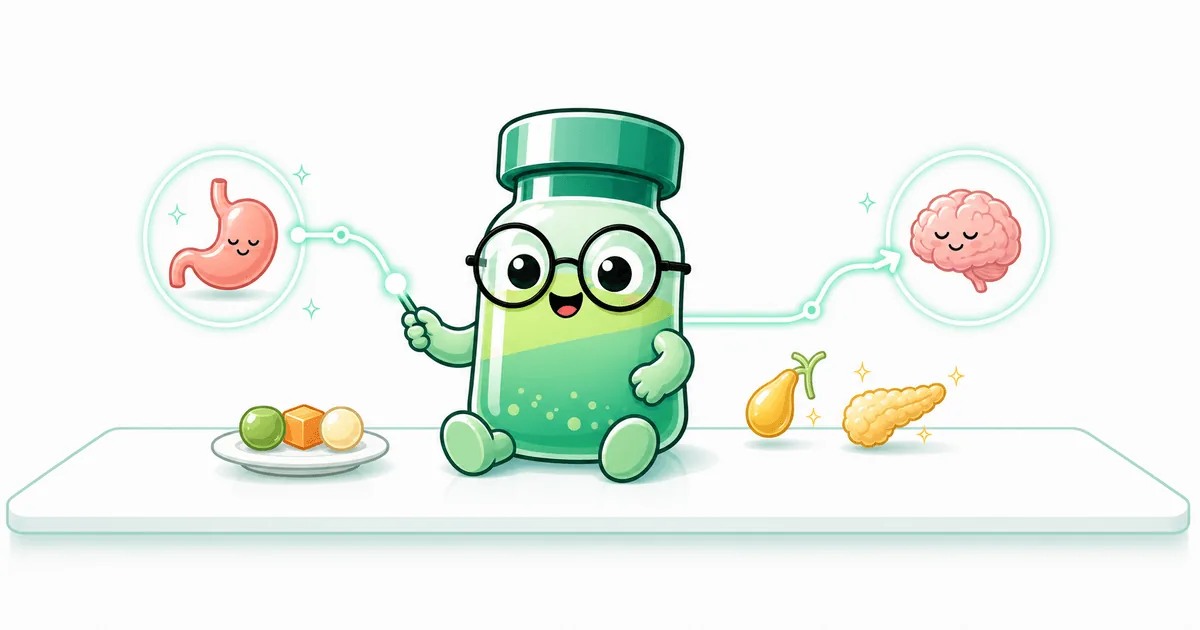
Cholecystokinin is a gut-brain peptide best known for three things: it contracts the gallbladder, releases pancreatic enzymes, and tells the brain a meal is done. It also drives panic-like symptoms in CCK-4 research paradigms. This page covers the receptor biology, the satiety and panic data, and where CCK drug development stands. Educational only, no doses.
For educational purposes only, not medical advice. This page is written for patients and the general public learning the science. It is not clinical guidance and does not recommend any peptide, dose, or treatment plan. Consult a licensed healthcare provider before using any peptide product.
Cholecystokinin (CCK) is a peptide hormone and neurotransmitter that signals through two receptors, CCK-A (peripheral, satiety, gallbladder, pancreas) and CCK-B (central and gastric, shared with gastrin). It is one of the original gut-brain satiety hormones and is the molecule behind the CCK-4 panic-provocation test in psychiatric research. It has no approved drug use, but it remains a foundational example of gut-brain signaling.
What is CCK?
CCK was identified as a gallbladder-contracting and pancreatic-enzyme-releasing factor in the 1920s and was originally called "pancreozymin" until that activity was traced to the same molecule. It exists in several length variants (CCK-8, CCK-33, CCK-58, CCK-4) that share a common C-terminal recognition motif.
The protein is encoded by a single gene and is processed in I cells of the proximal small intestine and in central nervous system neurons. The biologically active forms differ in length but all end in the same C-terminal pentapeptide, Gly-Trp-Met-Asp-Phe-NH2, which is the sequence that binds the CCK receptors. Gastrin shares the same C-terminal pentapeptide, which is why CCK and gastrin cross-react at the CCK-B receptor and why CCK-B is sometimes called the CCK/gastrin receptor [1].
From a teaching standpoint, CCK is unusually clean. The same gene produces a hormone in the gut that drives digestion and satiety, and a neuropeptide in the brain that influences mood, anxiety, dopaminergic tone, and analgesia. Almost every gut-brain story in modern neuroscience leans on CCK as the prototype.
How does it signal?
CCK signals through two G-protein-coupled receptors. CCK-A (also called CCK1R) is the peripheral receptor responsible for gallbladder contraction, pancreatic enzyme release, and the gut-brain satiety signal. CCK-B (CCK2R) is mostly central and gastric and is the receptor that also binds gastrin.
Both receptors are Gq-coupled GPCRs that raise intracellular calcium when activated. Peripherally, CCK-A activation on smooth muscle and acinar cells drives gallbladder contraction and pancreatic enzyme release; CCK-A activation on vagal afferents in the gut wall sends a satiety signal up to the brainstem, where it integrates with leptin, GLP-1, PYY, and other signals to terminate the meal [2].
Centrally, CCK-B is densely expressed in the cortex, amygdala, hippocampus, and brainstem. CCK-B activation has been linked to anxiety, panic-like behavior, and pain modulation, and CCK-B antagonists were a major focus of anxiolytic drug development in the 1990s. The CCK-A and CCK-B receptor split makes CCK an unusually clean teaching example of how a single peptide family can produce very different physiology depending on which receptor and which tissue is engaged.
CCK in satiety
CCK was one of the first "gut hormone causes satiety" stories in modern endocrinology. Intravenous CCK-8 or CCK-33 in humans reproducibly reduces meal size and reported hunger. That finding fueled an entire generation of CCK-A agonist obesity programs, all of which failed clinically. Rapid tolerance is the preclinical explanation usually given, but the largest human trial failed on efficacy outright.
The foundational satiety work was published by Smith, Gibbs, and colleagues in the 1970s, who showed that exogenous CCK reduced meal size in rats and, in follow-on human studies, in healthy volunteers [3]. The effect is real and reproducible on acute infusion: meal size drops, meal duration shortens, and reported fullness rises. The trouble shows up on repeated dosing.
Multiple selective CCK-A agonists were developed as oral obesity drugs in the 2000s. The canonical example was GI 181771X, and its 24-week trial in 701 patients is more damning than a fade: it did not reduce body weight at all, nor waist circumference, nor any other cardiometabolic marker. Gastrointestinal side effects were more common than on placebo, while the hepatobiliary and pancreatic abnormalities the mechanism predicts did not occur. The authors' own conclusion is that CCK-A by itself has no central role in long-term energy balance [4]. The program was discontinued. The broader lesson: CCK works as a single-meal termination signal, but engaging it pharmacologically did not translate into sustained weight loss, and the GLP-1 family became the practical satiety axis instead.
CCK in panic and anxiety
The CCK-4 panic-provocation test is one of the most reliable human panic models in psychiatry. Intravenous CCK-4 (the C-terminal tetrapeptide of CCK) triggers panic-attack-like symptoms in healthy volunteers and triggers them more readily and more severely in panic-disorder patients. This finding made CCK-B a major anxiolytic drug target.
The original observation came from Bradwejn, Koszycki, and colleagues at the University of Ottawa in the late 1980s. Their controlled studies showed that a single IV bolus of CCK-4 induced panic in roughly 100% of panic-disorder patients and a substantial fraction of healthy controls, with classic symptoms (chest tightness, dyspnea, dizziness, fear of dying) appearing within minutes [5]. The response was blocked by CCK-B antagonists, anchoring the receptor pharmacology.
The obvious next step was a CCK-B antagonist anxiolytic drug. Several CCK-B antagonists, including L-365,260 and CI-988, reached early clinical trials in panic disorder and generalized anxiety in the 1990s. The results were disappointing: animal-model efficacy did not translate to clean human efficacy, and the programs were discontinued [6]. CCK-B remains a research target, but the CCK-4 paradigm is now used mostly as a tool for studying panic neurobiology and screening anxiolytic mechanisms rather than as a route to a CCK-B-directed drug.
Where it fits in the broader peptide landscape
CCK is one of the foundational gut-brain peptides and a recurring teaching example of how a single peptide family can produce very different physiology in the gut and in the brain. Its lessons matter for both the satiety story and the anxiety story.
On the appetite side, the natural comparison is bombesin and neuropeptide Y, the two other classical satiety-axis peptides that fed early obesity programs. All three were eclipsed clinically by the GLP-1 family, which is covered in our GLP-1 comparison and in the modern GLP-1 peptides semaglutide and tirzepatide. CCK reduces meal size, NPY drives hunger, and GLP-1 is the axis that turned out to be drug-tractable.
On the central side, CCK sits with enkephalin and the broader endogenous-peptide neurochemistry as a peptide that the brain uses for fast, local signaling. Unlike enkephalin, CCK actively drives anxiety-like states rather than analgesia. The cross-talk between CCK-B and opioid signaling is itself a long-standing pain-research topic, with CCK acting as an anti-opioid signal that can blunt morphine analgesia in animal models.
Safety, status, and honest framing
There is no FDA-approved CCK agonist or antagonist for satiety, anxiety, or any other indication. Native CCK-8 and CCK-4 are used in clinical and research settings (CCK-8 historically as a provocation agent in gallbladder imaging, CCK-4 in psychiatric panic-provocation paradigms), but neither is a marketed chronic therapeutic.
The acute safety profile of native CCK in clinical and research use is well-characterized: gallbladder pain, nausea, transient flushing, and, in CCK-4 paradigms, the panic-attack-like response described above. Chronic CCK-A agonist exposure in the obesity development programs raised concerns about gallbladder and pancreatic side effects, which is consistent with the receptor distribution. Chronic CCK-B engagement has never been carried far enough in humans to characterize.
Honest framing: CCK is a foundational peptide for understanding the gut-brain axis and a recurring example of why an effective acute pharmacology does not automatically become a chronic drug. It is not a consumer peptide. Any product sold as CCK to consumers for weight loss or anxiety is outside any regulated pathway and contradicts the actual clinical history.
Frequently asked questions
Cholecystokinin (CCK) is a peptide hormone and neurotransmitter released by enteroendocrine I cells in the small intestine and by neurons in the central nervous system. Its three best-known peripheral roles are contracting the gallbladder, releasing pancreatic digestive enzymes, and signaling meal termination through vagal afferents to the brainstem.
CCK-A (also called CCK1R) is the peripheral receptor that mediates gallbladder contraction, pancreatic enzyme release, and the gut-brain satiety signal. CCK-B (CCK2R) is the central and gastric receptor that also responds to gastrin. CCK-B activation in the brain has been linked to anxiety and panic, and is the target of the CCK-4 panic-provocation paradigm.
CCK-4 (the C-terminal tetrapeptide of cholecystokinin) is a CCK-B agonist that reliably triggers panic-attack-like symptoms when injected intravenously in healthy volunteers and is even more potent in patients with panic disorder. CCK-4 has become a standard research-grade panic-provocation tool to study panic biology in a controlled setting.
No. native CCK-8 reproducibly reduces meal size when infused in humans, and CCK-A agonists were pursued as obesity drugs through the 2000s, but the programs failed on efficacy: the 24-week trial of GI 181771X in 701 patients did not reduce body weight, waist circumference, or any other cardiometabolic marker, and its authors concluded that CCK-A alone has no central role in long-term energy balance. The GLP-1 family eclipsed CCK as the practical pharmacology of satiety.
Yes. CCK and gastrin share the same C-terminal pentapeptide sequence (Gly-Trp-Met-Asp-Phe-NH2), which is the key recognition motif for the CCK-B receptor. That homology explains why CCK-B is sometimes called the CCK/gastrin receptor and why selective CCK-B antagonists are studied in both anxiety and acid-secretion contexts.
This page is the free overview. For a broader tour of the GLP-1 family and how peptides reshape appetite and fat distribution, see the GLP-1 comparison and the peptides and your body module.
References (6)
- Dufresne M, Seva C, Fourmy D. Cholecystokinin and gastrin receptors. Physiol Rev. 2006;86(3):805-847. PMID 16816139.
- Moran TH, Kinzig KP. Gastrointestinal satiety signals II. Cholecystokinin. Am J Physiol Gastrointest Liver Physiol. 2004;286(2):G183-G188. PMID 14715515.
- Gibbs J, Young RC, Smith GP. Cholecystokinin decreases food intake in rats. J Comp Physiol Psychol. 1973;84(3):488-495. PMID 4745816.
- Jordan J, Greenway FL, Leiter LA, et al. Stimulation of cholecystokinin-A receptors with GI181771X does not cause weight loss in overweight or obese subjects. Clin Pharmacol Ther. 2008;83(2):281-287. PMID 17597711.
- Bradwejn J, Koszycki D, Shriqui C. Enhanced sensitivity to cholecystokinin tetrapeptide in panic disorder: clinical and behavioral findings. Arch Gen Psychiatry. 1991;48(7):603-610. PMID 2069490.
- Kramer MS, Cutler NR, Ballenger JC, et al. A placebo-controlled trial of L-365,260, a CCKB antagonist, in panic disorder. Biol Psychiatry. 1995;37(7):462-466. PMID 7786960.
Ready to go deeper?
The Peptides Academy course library covers the full landscape of peptide families with mechanism explainers, evidence reviews, and interactive tools. Browse the catalog and see what fits your learning goals.
See pricing ›