
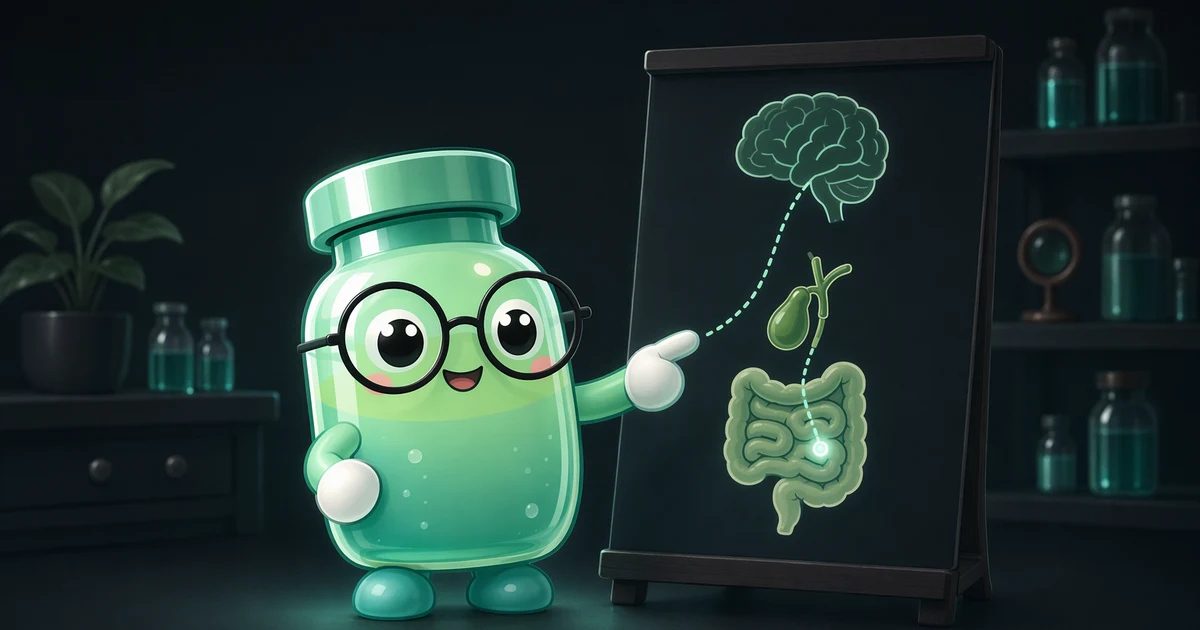
What is CCK? The cholecystokinin hormone explained
CCK is one of the oldest known gut hormones and the most abundant peptide messenger in the brain. What it is, where it is made, what it does after a meal, what the CCK-B receptor is, and why it never became a weight-loss drug.
For educational purposes only, not medical advice. CCK is a hormone your body makes; the CCK-based medicine approved in the United States, sincalide, is an injection used for diagnostic tests. Nothing here is a suggestion to take, buy or avoid anything. Questions about your digestion, gallbladder or appetite belong with a clinician who knows your history.
What is CCK?
CCK, short for cholecystokinin, is a peptide hormone made by cells in the lining of the small intestine and by nerve cells in the brain. After a meal it makes the gallbladder squeeze, tells the pancreas to release digestive enzymes and helps signal that you are full. It is also the most abundant neuropeptide in the human brain.
CCK stands for cholecystokinin, a name built from Greek roots meaning "moves the gallbladder". That is exactly how it was found. In 1928, Ivy and Oldberg showed that a factor from the upper gut made the gallbladder contract and that it was not secretin, the first gut hormone ever discovered, so they named the new hormone CCK [2]. A later review describes it the same way: discovered in 1928 in extracts of the small intestine as a gallbladder contraction factor [1].
It took four decades to learn what the factor actually was. Its structure, published in 1968, was a peptide with a sequence of 33 amino acid residues [2], a short chain of amino acids like the ones covered in our peptide basics module. Today we know the CCK gene produces several sizes of the same messenger: six different bioactive peptides, from CCK-83 down to CCK-5, in sulfated and non-sulfated forms [3]. The family is ancient: a recent review puts its history at nearly 600 million years [3].
Together with secretin and gastrin, CCK makes up the classical trio of gut hormones [5]. But calling it only a gut hormone undersells it. CCK is made in two main places, endocrine I-cells in the small intestine and nerve cells in the brain [1], and it is the most abundant neuropeptide in the human brain [5]. So CCK is both a hormone carried in the blood and a neurotransmitter passed between neurons.
Where is CCK made, and what makes it rise?
In the gut, CCK comes from I-cells in the lining of the small intestine, released when protein and fat arrive from the stomach; carbohydrates release only small amounts. Blood levels sit around 1 pmol/l between meals and rise to 3 to 5 pmol/l within 20 minutes of eating.
The CCK in your bloodstream comes mainly from I-cells, scattered hormone-making cells in the lining of the small intestine whose surface is in contact with the inside of the gut [1]. Textbooks often call CCK a duodenal hormone, after the first stretch of the small intestine, but a recent review by Jens Rehfeld calls that misleading: I-cells run on through the jejunum and ileum, and because those segments are so much longer, each makes considerably more CCK than the duodenum does [2].
What switches the I-cells on is the meal itself. Specific blood assays have confirmed that protein- and fat-rich food is the most important stimulus, while carbohydrates release only small amounts of CCK [1]. This is the answer to the common question about which foods release CCK: it is the protein and fat in a meal, not a particular ingredient.
The amounts are low compared with most other gut and pancreatic hormones [1]. Between meals the concentration of CCK in plasma is around 1 pmol/l, often less; it rises within 20 minutes of eating to 3 to 5 pmol/l, falls back, and then reaches a second peak after 1.5 to 2 hours [1]. In people, CCK-33 is the main form in the blood [1].
The brain is a bigger factory still. Most CCK in mammals is made not in the gut but in neurons, and by its messenger RNA the brain expresses four to five times more CCK than the lining of the small intestine [2].
What does CCK do in digestion?
CCK coordinates the response to a fatty, protein-rich meal. It makes the gallbladder contract and the sphincter of Oddi relax so bile reaches the intestine, drives the pancreas to release digestive enzymes, slows how fast the stomach empties, and reduces stomach acid through somatostatin.
Think of CCK as the signal that says "fat and protein have arrived, send the tools to digest them". Through its first receptor, CCK mediates gallbladder contraction, relaxation of the sphincter of Oddi (the valve where bile and pancreatic juice enter the intestine), pancreatic growth and enzyme secretion, delay of gastric emptying, and inhibition of gastric acid secretion via somatostatin in the stomach [1].
- Bile. Bile from the liver is stored in the gallbladder. CCK releases it into the intestine through rhythmic contraction and relaxation of the muscles of the bile duct and the sphincter of Oddi [1].
- Pancreatic enzymes. CCK regulates the secretion of pancreatic enzymes so potently that it seems sufficient to account for all enzyme secretion [1].
- Pace. CCK delays gastric emptying, so food leaves the stomach more slowly [1].
- Acid. CCK reduces stomach acid indirectly, by releasing somatostatin, a hormone that acts as a brake [1].
Changes in CCK release turn up in some digestive conditions: CCK secretion is impaired in celiac disease and bulimia nervosa [5]. A recent review adds some perspective on the gallbladder: gallstone attacks are painful, but surgical removal is today fast and uncomplicated, and life without a gallbladder is pretty normal [2].
CCK receptors: CCK-A, CCK-B and gastrin
CCK acts through two main receptors. CCK-A, now called CCK1, is the "alimentary" receptor behind gallbladder, pancreas and fullness effects, and it only binds the sulfated form of CCK. CCK-B, or CCK2, is the main receptor in the brain and is identical to the stomach's gastrin receptor.
If you met these receptor names in a physiology course, here is the short version. CCK and gastrin, the stomach's acid hormone, belong to one family of related peptides, and both are natural keys for the gastrin/CCK-B receptor, while the CCK-A receptor binds only sulfated CCK peptides [4].
- CCK-A, or CCK1, the "alimentary" receptor. It handles the digestive jobs in the section above and the fullness signal below. It is picky: it requires a sulfate group on one tyrosine in CCK, which is why gastrin barely touches it [1].
- CCK-B, or CCK2, the "brain" receptor. It is the main CCK receptor in the brain, and the gastrin receptor cloned from the stomach turned out to be the same receptor [1]. It binds sulfated and unsulfated forms equally well [1].
The overlap with gastrin is why the two hormones are so often taught together. Gastrin is made mainly in G-cells of the lower stomach (the antrum) and the duodenum and regulates acid secretion and the growth of the stomach lining [4]; CCK is made in I-cells further down and in neurons. A third CCK receptor, GPR173, has recently been identified in brain tissue, and its role outside the brain is still unpublished [2].
Does CCK make you feel full?
Yes, in the short term. CCK was the first gut signal shown to reduce food intake: in an early human study, an infusion made 12 lean men eat on average 122 g less and stop sooner. The signal travels up the vagus nerve to the brain. It shortens a meal; on its own it does not set body weight.
CCK has a place in appetite science that no other gut hormone can claim. In 1973, Gibbs and colleagues discovered that CCK given from outside the body inhibits food intake [1], and a recent review calls it the first intestinal satiety signal ever discovered [2]. Satiety here means the feeling that ends a meal.
Human experiments followed. In one study, an intravenous infusion of CCK-8, the short eight-amino-acid form, decreased food intake by an average of 122 g in 12 lean men compared with saline, and the men ate less and stopped eating sooner [6]. A follow-up by the same group found the same in obesity: six of eight obese men ate significantly less food during the infusion than during saline [7].
The route is a nerve, not the bloodstream to the brain. CCK acts on CCK1 receptors on the vagus nerve, which runs from the gut to the brainstem [1], and the signal then reaches the hypothalamus through the brainstem's nucleus tractus solitarius and area postrema [1]. It works alongside GLP-1 and PYY, other gut hormones that signal to the brain through the same vagal fibres to regulate food intake [2].
One finding surprises people: CCK is not low in obesity. Plasma CCK, fasting and after mixed meals, is the same in lean and obese people [2], and the review concludes that the CCK changes found in obesity and eating disorders are modest and hardly decisive [2].
Why there is no CCK weight-loss drug
Because when the idea was put to a proper test, it failed. In a 24-week trial, 701 people with overweight or obesity took a CCK1 receptor drug, GI181771X, or placebo alongside a calorie-reduced diet. It did not reduce body weight or waist size, and gut side effects were more common than on placebo.
If CCK makes people eat less, why is there no CCK version of semaglutide? The authors of the first human study themselves thought the octapeptide offered promise as an appetite suppressant [6]. The decisive test came decades later.
In a double-blind trial, patients with obesity, or with overweight plus risk factors, were randomized to 24 weeks of GI181771X, a drug that activates the CCK1 receptor, at different doses, or to matching placebo, together with a calorie-reduced diet [8]. In total 701 patients were randomized [8]. GI181771X did not reduce body weight and had no effect on waist circumference or other cardiometabolic risk markers, and gastrointestinal side effects were more common than on placebo [8]. The authors' conclusion was blunt: CCK-A by itself does not have a central role in long-term energy balance [8].
That is the main difference from GLP-1. A CCK signal ends a meal, but in this trial making that signal stronger for 24 weeks did not change weight [8]. Drugs built on GLP-1 and GIP, by contrast, are now used widely to treat diabetes and obesity [2]; our GLP-1 comparison covers what those trials found. CCK has not disappeared from metabolic research: for diabetes, a recent review says that for safety reasons any attempt to use a CCK receptor agonist would have to be low doses in combination with analogues of the major incretins such as GLP-1 [2].
CCK in the brain: memory and anxiety
In the brain CCK is a neurotransmitter, released by neurons rather than carried in blood. Mice without the CCK gene lose memory and show more anxiety. In people, the tiny fragment CCK-4 can trigger panic attacks, which is why researchers use it to study panic disorder.
CCK is the predominant peptide transmitter in the brain, present in amounts that surpass any other neuropeptide [3]. Its job there is still being mapped, but two lines of evidence stand out.
The first is memory. Mice bred without a working CCK gene lose their memory and show increased anxiety [2].
The second is panic. Giving CCK-4, a four-amino-acid fragment that acts on the CCK-B receptor, induces panic attacks of anxiety, and human subjects have been carefully studied [2]. That is why researchers use CCK-4 to study panic under controlled conditions. In one study, 92 healthy men and women with no psychiatric history received CCK-4 so researchers could test whether variants of the CCK-B receptor gene changed their response; they did not [9]. In another, a randomized, double-blind study, twenty-four adult volunteers received CCK-4 or placebo while their brain activity was recorded [10]. These are laboratory challenges in volunteers, not treatments.
Is CCK used as a medicine?
Yes, as a diagnostic, not a treatment. Sincalide, sold as Kinevac, is a synthetic copy of the C-terminal octapeptide of CCK, its last eight amino acids. It is injected to make the gallbladder contract during imaging, to collect pancreatic secretions, or to speed a barium meal through the small bowel.
The medical use of CCK follows directly from its name. Sincalide, sold in the United States as Kinevac, is described on its label as a synthetically prepared C-terminal octapeptide of cholecystokinin [11], in other words the eight-amino-acid fragment of CCK made in a laboratory. Its approved uses are all diagnostic:
- Making the gallbladder contract so it can be assessed with imaging, or collecting concentrated bile for analysis [11].
- Stimulating pancreatic secretion, together with secretin, before a sample is taken for analysis [11].
- Speeding a barium meal through the small bowel during X-ray studies [11].
That matches the older literature, which describes stimulation with CCK as useful in diagnostic tests of gallbladder and pancreatic diseases and of medullary thyroid carcinomas [5]. When given as a quick intravenous injection, the label warns it may cause transient nausea, vomiting, abdominal pain or cramping, dizziness or flushing [11], and to reduce that risk the label calls for giving it as a slower intravenous infusion [11]. It is a test drug; its label lists no use for appetite or weight.
Frequently asked questions
CCK, or cholecystokinin, is a peptide hormone and neurotransmitter. In the gut it is released by I-cells in the small intestine after a meal and makes the gallbladder contract, drives pancreatic enzyme secretion, slows stomach emptying and signals fullness. In the brain it is the most abundant neuropeptide. It was named in 1928.
Through its CCK1 receptor it makes the gallbladder contract, relaxes the sphincter of Oddi, stimulates pancreatic enzyme secretion, delays gastric emptying and reduces stomach acid through somatostatin. It also shortens meals by signalling fullness through the vagus nerve, and it acts as a neurotransmitter in the brain.
In the gut, by endocrine I-cells in the lining of the small intestine, through the duodenum, jejunum and ileum, and in nerve cells of the brain and the gut. Most CCK in mammals is actually made in neurons: by its messenger RNA the brain expresses four to five times more CCK than the intestinal lining.
Protein- and fat-rich food is the most important stimulus for CCK release, while carbohydrates release only small amounts. Blood levels rise from around 1 pmol/l between meals to 3 to 5 pmol/l within 20 minutes of eating.
CCK-B, now called CCK2, is the main CCK receptor in the brain. It is identical to the gastrin receptor of the stomach and binds both sulfated and unsulfated CCK as well as gastrin. The other receptor, CCK-A or CCK1, handles the digestive and fullness effects and binds only sulfated CCK.
No, but they are relatives. CCK and gastrin are the only mammalian members of the same peptide family and share the CCK-B receptor. Gastrin is made mainly in G-cells of the stomach and regulates acid secretion; CCK is made in I-cells of the small intestine and in neurons and mainly regulates the gallbladder, pancreas and fullness.
Not on its own, as far as trials show. CCK shortens a single meal, but in a 24-week trial of 701 people, the CCK1 receptor drug GI181771X did not reduce body weight or waist size compared with placebo and caused more gut side effects. Plasma CCK is also the same in lean and obese people.
Yes. CCK is a peptide, a short chain of amino acids. The form first identified in 1968 has 33 amino acids, and the CCK gene produces six bioactive forms from CCK-83 down to CCK-5. The medicine sincalide is a synthetic copy of the eight-amino-acid form, CCK-8.
References
- Rehfeld JF. "Cholecystokinin: from local gut hormone to ubiquitous messenger." Front Endocrinol (Lausanne). 2017. PMID 28450850 DOI
- Rehfeld JF. "Cholecystokinin: clinical aspects of the new biology." J Intern Med. 2025. PMID 40557463 DOI
- Rehfeld JF. "Cholecystokinin: portrayal of an unfolding peptide messenger system." Peptides. 2025. PMID 39983917 DOI
- Rehfeld JF, Friis-Hansen L, Goetze JP, Hansen TV. "The biology of cholecystokinin and gastrin peptides." Curr Top Med Chem. 2007. PMID 17584137 DOI
- Rehfeld JF. "Clinical endocrinology and metabolism. Cholecystokinin." Best Pract Res Clin Endocrinol Metab. 2004. PMID 15533776 DOI
- Kissileff HR, Pi-Sunyer FX, Thornton J, Smith GP. "C-terminal octapeptide of cholecystokinin decreases food intake in man." Am J Clin Nutr. 1981. PMID 6259918 DOI
- Pi-Sunyer X, Kissileff HR, Thornton J, Smith GP. "C-terminal octapeptide of cholecystokinin decreases food intake in obese men." Physiol Behav. 1982. PMID 6294699 DOI
- Jordan J, Greenway FL, Leiter LA, Li Z, Jacobson P, Murphy K, Hill J, Kler L, Aftring RP. "Stimulation of cholecystokinin-A receptors with GI181771X does not cause weight loss in overweight or obese patients." Clin Pharmacol Ther. 2008. PMID 17597711 DOI
- Koszycki D, Prichard Z, Fiocco AJ, Shlik J, Kennedy JL, Bradwejn J. "CCK-B receptor gene and response to cholecystokinin-tetrapeptide in healthy volunteers." Peptides. 2012. PMID 22414867 DOI
- Knott V, Mahoney C, Bradwejn J, Shlik J, Gunnarsson T. "Effects of acute cholecystokinin infusion on hemispheric EEG asymmetry and coherence in healthy volunteers." Prog Neuropsychopharmacol Biol Psychiatry. 2003. PMID 12551742 DOI
- Bracco Diagnostics Inc.. "KINEVAC (sincalide) for injection: US prescribing information." DailyMed, US National Library of Medicine. 2023. Source