
Cloudy peptide after reconstitution: why it happens, and when to throw the vial out
You add the water, the powder dissolves, and the liquid comes out hazy. Some guides say wait, some say add acid, some say it is fine. The approved peptide injections all set one standard, clear, and the chemistry explains why.
For educational purposes only, not medical advice. Retatrutide is not approved anywhere, and research peptides are not approved for use in people. This article does not recommend obtaining, mixing or injecting any of them, and it names no dose and no supplier. The appearance rules quoted below come from the patient information of approved products and are reported as what those documents say, not as a validated test for any research peptide.
Is a cloudy peptide still good to use?
No. Every approved peptide injection whose patient information we read, tesamorelin, semaglutide, tirzepatide and glucagon, says the solution should be clear, and three say outright not to use it cloudy. Research peptides have no label at all, so the strictest rule that exists is the one to borrow: a solution that stays cloudy gets discarded.
Research peptides come with no label, so there is no official appearance standard for a vial of retatrutide or BPC-157. Approved peptide injections do have one, and on this question they agree. Tesamorelin is the closest match to how research peptides are handled, because it also comes as a powder to be mixed with a liquid before injection. Its patient information says to look at the solution after mixing, that it should be clear and colorless with no particles in it, and not to use it if it is colored, cloudy, contains particles [1].
The ready-made injections say the same. Semaglutide should be clear, colorless, and free of particles, and is not to be used if it is colored, cloudy, thickened, or contains solid particles [2]. Tirzepatide should be clear, colorless to slightly yellow and free of particles [3]. Glucagon, which also comes as a powder to be mixed, should be clear, colorless to pale yellow, and free of particles, and is not to be used if it is cloudy [4].
Those rules were written for those products, not for yours. But they are the closest thing to an appearance standard for peptide injections, and none of the four says a cloudy solution is acceptable [1][2][3][4]. That is the default this article starts from. The rest explains why it is the right one, and the one exception people get confused by.
Cloudy, foamy or not dissolved yet?
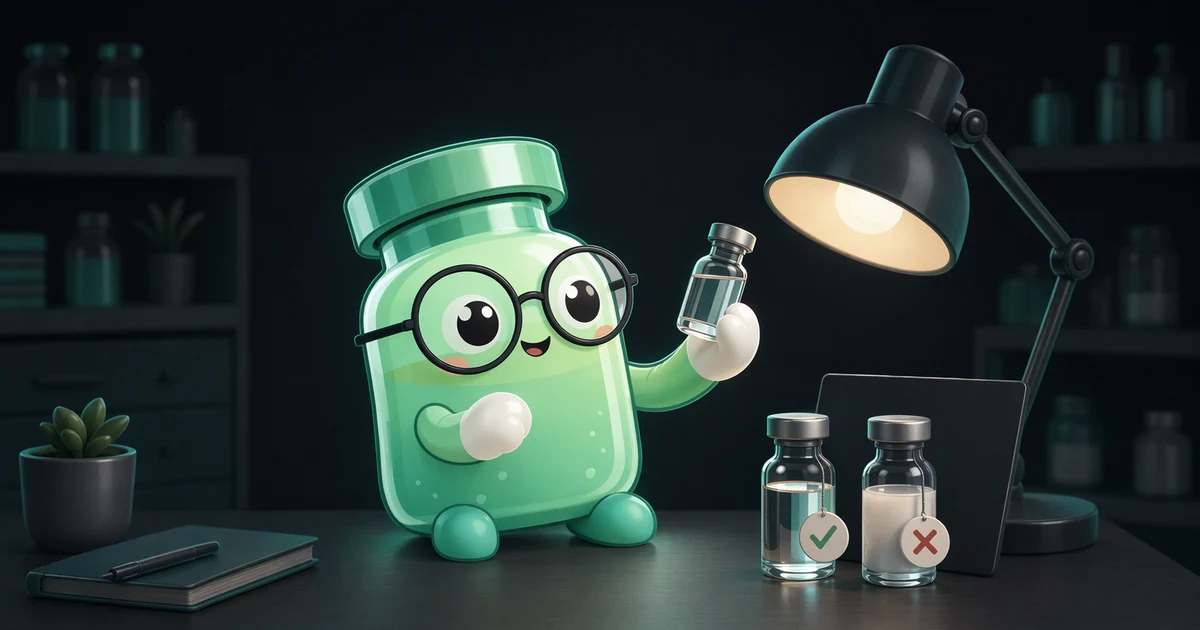
Three things look alike in the first minute. Bubbles and foam rise and pop. Undissolved powder shows as specks or a film that shrinks as the vial sits. Haze spread evenly through the liquid, that does not settle and does not clear, is the one that counts as cloudy. Shaking adds foam and can cause the haze itself.
Most "my peptide is cloudy" moments happen in the first minute after the water goes in, and not all of them are cloudiness. Before deciding anything, it helps to tell three things apart.
Bubbles and foam sit at the top or cling to the glass, and they rise and break up as the vial rests. Undissolved powder shows as specks, flakes or a film on the glass, and it gets smaller as the liquid works into it. Haze is different: an even milkiness through the whole liquid, which is still there after the bubbles have gone and the powder has disappeared. Haze is what the labels mean by cloudy.
The way the vial is handled matters for all three. A formulation review of therapeutic peptides says it is crucial to handle the peptides gently and avoid agitation or shear stress, and lists freezing, heating, or agitation among the stress conditions that may induce aggregation, meaning peptide molecules clumping together [6]. The same review hints at why shaking is a problem: polysorbates, a kind of surfactant, can reduce agitation-induced aggregation of peptides, presumably because they cut the peptide's exposure to the air/liquid interface [6]. Foam is a great deal of air/liquid interface. So the usual reconstitution advice, to let the water run down the inside of the glass and swirl or roll the vial rather than shake it, has a reason behind it. Our peptide reconstitution guide walks through the technique.
Why peptides turn cloudy: aggregation
Lasting haze usually means aggregation: peptide molecules sticking to each other in clumps large enough to scatter light. Some aggregation reverses and some does not. Either way, a review of peptide therapeutics says it can cost activity and raise problems of toxicity and immunogenicity, meaning an immune reaction against the drug.
A peptide in solution is meant to exist as single molecules floating apart from each other. Aggregation is what happens when they stick together instead. A review of the physical stability of peptide therapeutics calls it one of the most common and troubling processes in drug development, and describes two kinds of clump: amorphous aggregates, which are disordered, and highly ordered strands called fibrils [5]. When enough molecules clump, the clumps become large enough to scatter light, and the liquid looks hazy.
The review gives two facts that matter for a vial on a kitchen counter. First, in some cases, aggregation is reversible while in others it is effectively irreversible. Second, in either case it reduces the peptide's stability, not only leading to a loss in activity but also other critical problems such as toxicity and immunogenicity [5]. Immunogenicity means the body mounting an immune response against the drug. So the concern is not only that the dose is weaker than the label on the vial says. It is also that clumped peptide is a different thing to inject.
The peptide family most people ask about is not immune to this. The review lists native GLP-1 and glucagon among the peptides shown to form fibrils under some laboratory conditions, and shows images of GLP-1 in plain water forming amorphous aggregates after a week at room temperature [5]. Those are laboratory experiments on the natural hormones, not tests of any drug or research product. We found no published data on how retatrutide or compounded tirzepatide behave in a home vial, which is exactly why the visual rule matters.
Cloudy right after mixing, or cloudy days later
When the haze appears tells you something, but not enough to keep the vial. Haze from the start points to how the powder dissolved: too much peptide in too little water, the wrong conditions, or rough handling. Haze that appears in a vial that was clear points to aggregation over time, or contamination. Both end in discard.
Haze that shows up the moment you mix and stays has to do with the conditions in the vial. The aggregation review names peptide concentration as one of the most important factors in physical stability, and notes that aggregation may not be a significant issue at low peptide concentrations but can become a serious problem at high concentrations [5]. It also says that pH and the salts in a solution can all have a dramatic effect on both the rate and extent of aggregation [5]. A lot of peptide pushed into a little water, rough handling, or a peptide that simply does not like the liquid it was given can all leave the solution hazy from the start.
Haze that appears in a vial that was clear yesterday is a different signal. Either the peptide has been aggregating slowly as it sat, which the review shows can happen over a week at room temperature, or something has been growing in the liquid. The formulation review notes that reconstitution itself poses a risk of contamination [6], and every needle that goes through the stopper is another chance. You cannot tell from looking which of the two you have.
That is why the timing does not rescue the vial. CDC's injection-safety guidance says to always discard medication vials whenever sterility is compromised or questionable [8]. A vial that has clouded for no reason you can name is a questionable one. For how long a clear mixed vial should be kept in the first place, see how long reconstituted peptides last.
The one injection that is supposed to be cloudy
Cloudy is not bad for every injectable. NPH insulin is a suspension and should look cloudy or milky after mixing, while regular insulin should be as clear as water and is discarded if cloudy. What decides it is the product's own appearance standard, and every peptide solution above is meant to be clear.
Part of the confusion online comes from people who have used insulin. Human insulin is sold two ways: as a solution, and as a suspension (liquid with particles that will settle on standing) [7]. The two have opposite rules. Regular insulin should be as clear, colorless, and fluid as water, and is not to be used if it appears cloudy, thickened, or colored. NPH insulin, the suspension, should appear cloudy or milky after you mix it, and is gently shaken or rolled before use [7].
So cloudiness is not good or bad in itself. It depends on what the product is designed to look like. A suspension is cloudy on purpose, with the drug held as fine particles. A solution is supposed to have everything dissolved, and haze in it means something has come out of solution. Every peptide covered above, tesamorelin, semaglutide, tirzepatide and glucagon, is described as clear [1][2][3][4], and a research peptide dissolved in water is a solution, not a suspension. Even NPH insulin has a discard rule: no clumps in the liquid and no solid white particles stuck to the bottle [7].
Acetic acid, warming and filters: do the fixes work?
None of the popular fixes appears in the approved patient information we read, and none can be checked at home. Changing the pH can speed aggregation as well as slow it. Filtering takes out clumped peptide along with the haze, so the dose drops by an unknown amount. Adding anything to the vial is another chance for contamination.
Search for a fix and you will find three: add a little acetic acid to change the pH, warm the vial, or push the liquid through a syringe filter. Some reports say the haze cleared. That may well be true, and it is still not the same as the vial being fine.
Acid. pH really does change aggregation, which is why the idea is not absurd. But the aggregation review warns that while it is easy to set rules of thumb about pH and charge, these rules should be viewed with caution, and it describes a GLP-1 case where the aggregation rate ran opposite to what simple charge rules predict [5]. Without knowing your peptide's chemistry and the liquid's pH, adding acid is a guess. Warming runs into a stress the formulation review lists by name: heating may induce aggregation [6]. Filtering does remove the visible clumps. If the haze is aggregated peptide, those clumps are the drug, so what is left in the vial is a smaller dose of an unknown size, and the review's point stands that aggregation can be effectively irreversible [5].
There is also the contamination question. CDC notes that the sterile compounding standard counts combining, admixing, diluting, pooling, reconstituting as sterile compounding [8], and every extra liquid and every extra needle through the stopper is another opening. A clear liquid after a home fix tells you the light is no longer scattering. It does not tell you how much intact peptide is left or whether the vial is still sterile.
Retatrutide, tirzepatide and semaglutide vials
Retatrutide is investigational and cannot legally be sold for human use, so no appearance standard exists for it. Approved tirzepatide and semaglutide do have one: clear, colorless or slightly yellow for tirzepatide, colorless for semaglutide, never cloudy. A compounded vial should be checked against the pharmacy's label, and the pharmacy called if it is cloudy.
The three compounds people most often ask about sit in three different places. Retatrutide has no label anywhere. Lilly describes it as an investigational molecule that cannot be legally sold or marketed for human use [9], so a vial bought online has no specification for what it should look like, and nobody has published how it behaves once mixed. Our retatrutide storage guide covers the rest of its handling.
Tirzepatide and semaglutide are approved, and their patient information sets the standard: tirzepatide clear, colorless to slightly yellow and free of particles [3], semaglutide clear, colorless, and free of particles, and not to be frozen [2]. A faint yellow tint in tirzepatide is within its own description. Haze is not.
Compounded versions are made by a pharmacy, and the pharmacy's label and instructions are the reference for that vial. If a compounded tirzepatide or semaglutide vial is cloudy, the pharmacy that made it is the one to call, before any dose is drawn. How long a compounded vial lasts once opened is covered in how long compounded semaglutide lasts. If you want to understand the drug itself first, our retatrutide course covers how the triple agonist works and what the trials found.
What to do with a cloudy vial, step by step
Let a freshly mixed vial rest and swirl it gently, never shake it. If it turns clear with no specks, it dissolved. If haze stays, or a clear vial turns cloudy, colored or grows particles, or if it ever froze, discard it. Do not add acid, warm it or filter it, and do not inject it.
Put together, the documents above support a short routine.
- Mix gently. Let the liquid run down the inside wall of the vial and swirl or roll it rather than shake it, since agitation is one of the stresses that may induce aggregation [6].
- Give it time. Set a freshly mixed vial down and let the bubbles rise and the powder finish dissolving before you judge it.
- Look properly. Hold it against light and against a dark background. The approved peptide standard is clear, with no particles [1][2].
- If haze stays, discard it. Do not add acid, warm it or filter it. Aggregation can be effectively irreversible and costs activity [5].
- If a clear vial turns cloudy later, discard it. CDC says to discard vials whenever sterility is compromised or questionable [8].
- If it froze, discard it, even if it looks normal. Freezing is one of the listed stresses for aggregation [6], and semaglutide's own information says not to freeze it [2].
One limit runs the other way. A clear vial is not proof of a good one. Chemical breakdown such as oxidation does not show to the eye, and the looks of a vial say nothing about what was in it on the day it arrived. Our guide to vetting research peptides covers what a certificate of analysis does and does not prove, and flying with peptides covers keeping a vial cold on the move, where freezing and heating accidents are easy.
Frequently asked questions
Haze that stays after the bubbles clear and the powder dissolves usually means aggregation, peptide molecules clumping together. High concentration, the pH of the liquid, shaking, heat and freezing all push peptides toward it. A vial that was clear and turned cloudy later may also be contaminated, and you cannot tell which by looking.
Every approved peptide injection whose patient information we read, tesamorelin, semaglutide, tirzepatide and glucagon, is meant to be clear, and three say outright not to use it cloudy. Aggregated peptide can lose activity and raise problems of toxicity and immunogenicity, and haze can also be contamination. Treat a solution that stays cloudy as one to discard.
Bubbles and undissolved powder usually do clear if the vial rests and is swirled gently. True haze is different. A review of peptide aggregation says some aggregation is reversible and some is effectively irreversible, and there is no way to know at home which you have. Haze that does not clear means discard.
Retatrutide has no label, so there is no official appearance standard for it. Lilly says it cannot be legally sold or marketed for human use. The approved peptides it is related to, semaglutide and tirzepatide, are meant to be clear, so a cloudy retatrutide vial falls in the same discard group.
No approved patient information we read describes it, and the result cannot be checked at home. pH does change aggregation, but a review of peptide aggregation warns that simple rules about pH should be viewed with caution. Every extra liquid and needle through the stopper also adds a contamination risk.
No. Yellow and cloudy are different things. The patient information for approved tirzepatide describes it as clear, colorless to slightly yellow and free of particles, so a faint yellow tint is within its own description. Haze, particles or a darker color are not. For a compounded vial, check the pharmacy's label.
NPH insulin is a suspension, made to hold the drug as fine particles, so it should look cloudy or milky after mixing. Regular insulin is a solution and is discarded if cloudy. A peptide dissolved in water is a solution, and the approved peptide injections we read are all described as clear.
References
- MedlinePlus, National Library of Medicine. "Tesamorelin injection." MedlinePlus drug information. 2026. Source
- MedlinePlus, National Library of Medicine. "Semaglutide injection." MedlinePlus drug information. 2026. Source
- MedlinePlus, National Library of Medicine. "Tirzepatide injection." MedlinePlus drug information. 2026. Source
- MedlinePlus, National Library of Medicine. "Glucagon injection." MedlinePlus drug information. 2026. Source
- Zapadka KL, Becher FJ, Gomes Dos Santos AL, Jackson SE. "Factors affecting the physical stability (aggregation) of peptide therapeutics." Interface Focus. 2017. PMID 29147559 DOI
- Nugrahadi PP, Hinrichs WLJ, Frijlink HW, Schöneich C, Avanti C. "Designing formulation strategies for enhanced stability of therapeutic peptides in aqueous solutions: a review." Pharmaceutics. 2023. PMID 36986796 DOI
- MedlinePlus, National Library of Medicine. "Human insulin injection." MedlinePlus drug information. 2026. Source
- Centers for Disease Control and Prevention. "Preventing unsafe injection practices." CDC clinical safety guidance. 2024. Source
- Eli Lilly and Company. "Lilly's triple agonist, retatrutide, successful in two additional Phase 3 obesity trials, delivering significant improvements in weight and A1C (TRIUMPH-2 and TRIUMPH-3)." PR Newswire, July 23, 2026. 2026. Source